ired, I Said.

vsvcr2s
Wayne Michael DeHart   (May, 1997)

Fired he said, you’re fired he said,
so drop what you’re doing and clean out your desk
and be gone by noon without disturbing the others
with shallow goodbyes and stuff like that
because you’re f ired , he said.

Six years of coming in early and leaving late
and skipping lunch and busting my butt for him.
Six years of showing up when I was sick
and missing vacations and covering up for him.

Tired he said,  I’m tired he said,
of your wrinkled shirts and shabby suits
and shoddy shoes that don’t present
the proper image to our clients but no more
because I’m t ired , he said.

Six years of working at home at night
and neglecting my wife and kids for him.
Six years of waiting for a “reserved for” space
in the company parking lot for him.

Required he said,  it’s required he said,
that you turn in your name-tag along with your keys
and fill out some forms and aren’t those company pens
I see in your pocket so best hand them over
because it’s requ ired, he said.

Six years of concessions and wounded pride
and loss of self-esteem for him.
Six years of cheap motels and burger joints
to lower expense accounts for him.

Retired he said, Black’s retired he said,
without warning at mid-morning
to move to Scranton or some such place
and now the reports won’t get finished
because Black’s ret ired, he said.

Six years of torture in this terrible place
had greatly increased my disgust for him.
Six years of suffering in submissive silence
had nurtured a nagging contempt for him.

Expired he said, White’s expired he said,
dropped down to the floor at ten forty-four
clutching his chest and gasping for breath
without giving notice so we’re short one more
because White’s exp ired, he said.

Six years of timid yes-sirs and no-sirs
to display the proper respect for him.
Six years of flattering his unsightly spouse
so she’d always be in a good mood for him.

Re-hired he said, you’ve been re-hired he said,
it’s been a morning of stress, strife and tension
with Black and White issues that need my attention
so be forever indebted to me for saving your pension
and work even harder,  so you’re re-h ired, he said.

(How the tables had turned! I wanted to smirk.
Too often scorned, now I’d deal with this jerk.
Whatever the cost, it was my time and place.
But … valor was lost, when he snarled in my face.)

Inspired I said,  I’m inspired I said,
by your faith in me, with this coveted chance
to re-establish my worth, to continue my career.
You’re a man I trust and revere, respect and hold dear,
and I’m so incredibly insp…

ired, I said.


146818

The Gray Two-Story Across From the Park

vsvcr2s
Wayne Michael DeHart   (May, 1997)

Our Home Becomes a House Again:

The last boxes of this and that have been laid to rest
in quiet scattered solitude on the hardwood floor,
awaiting only a lift from the Mayflower man.

The hallway closet where our coats used to rest,
now stripped of the garb it stored by the door,
mourns the transfer of treasures to a moving van.

Deserted hooks and naked nails hug walls undressed;
relieved of their duties, bearing burdens no more,
they loiter and litter each bland plaster span.

The gas range fumes at the loss of its pilot blue heat,
its burners absent their fire, missing their light;
tempered door open, oven breathing at last.

Powerless, the fridge sits stripped, silent in defeat;
fortress in white –  lifeline by day, beacon by night,
provider, safe harbor, its presence now passed.

As comforting sanctuary, as reassuring retreat,
the safe kitchen oasis offered exile from flight,
a nest that felt right, when life moved too fast.

Now just a building, idled realty,
abandoned forever by my family.
devoid of domain and dignity,
a rest stop in time, soon to be
nothing more than a memory.

That House Becomes A Home Again:

Change is afoot at the break of dawn.
U-Haul arrived, unloaded, withdrawn.

Kids running barefoot across the lawn.
Parents inside with curtains drawn.
They’ve moved in; we’ve moved on.
They be there and we be gone.
Makes them hither, makes us yon.

Makes us  . . . yawn.

#


(Aging nicely, some 60 years later,  though no longer gray,  no longer a home,  nor even a house in the traditional sense – now simply a soulless, sterile structure, i.e., a business office.) 

Maybe Just One Thing

vsvcr2s
Wayne Michael DeHart   (February, 1996)

I have had few good days of late.

At age 47, I have discovered that my dreams will not be realized.

Such discovery was not sudden. I have known for some time that I have been losing control of my life. Those around me define it as simply a mid-life crisis, an awakening of sorts, to the debilitating effects of time and spent emotion. This categorization of my condition is not accurate. I wish it were that simple, but it is not. Nothing is simple when you’re tired and alone at age 47. Tired and alone and beaten down by too many bad days.

So often I’ve heard people say they would decline an opportunity for a “do over,” an opportunity to go back in time and live their life over again.

To accept that opportunity would be to reject one’s past and present. Such rejection would be an admission of dissatisfaction, of poor choices, of failure. It would be a sign of weakness of mind and spirit. It would betray family and friends, It would be indefensible and unacceptable. It would strain the soul and hurt the heart.

I, however, would indeed go back. Without hesitation or trepidation. And I would do a thousand things differently.

Or maybe just one thing.

I would have seeded and nurtured friendships. My privacy and independence are false treasures I have guarded too closely through the years. To a fault, and to an obsession. Consequently, as I grew older (though upon reflection not wiser), I spent more and more time speculating, imagining, daydreaming, fantasizing  – always sure that there would eventually be time for fulfillment of every wish, every goal, every aspiration.

Time moves slowly for the young – a blessing unrecognized by those who count the days until they reached milestones of age 12, then 16, then 18, and finally 21. Milestones of a driver’s license, graduation, marriage, parenthood and the meaning of life.

I counted those days. Such a fool. I want them back. Each of them. All of them.

I would stop dreaming, and start living.

But now it’s too late for me, so I’ll settle for a  wish fulfilled. For a friend – one that will help make tomorrow a good day.

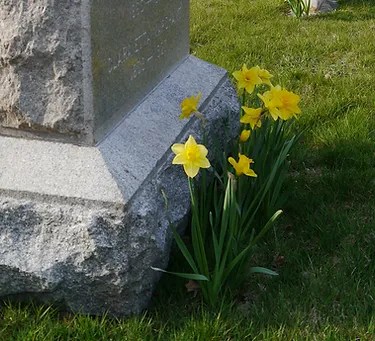
A friend that will care for me and about me. One that will be glad that I’m here, and will notice when I’m not. One that will leave Wordsworth’s beloved daffodils at my marker.

One that is real – in a world where nothing else is.

view from a hole

vsvcr2s
Wayne Michael DeHart    (September, 1996)

i look up and around as i slip down,
the light of tranquility fading

i scratch and i claw till my fingers are raw
losing my grip and my strength

i try hard to think as i continue to sink
to a depth too many have known

i curse my plight but continue to fight,
though my resistance mournfully wanes

my limbs are now weak and i can hardly speak
as the cylinder narrows its gauge

my will has expired and I’m so hopelessly tired
that i pray for the bottom to rise

but my descent is not done  (it’s just really begun)
so i resolve to shut down my mind

it’s my way to cope and cling to the hope
that my fall is really a stumble

and that i’ll awaken again
to a smile from a friend

illuminating . . .

this darkest of views
from this deepest of holes


#

ade559607

Annie’s Time

vsvcr2s
Wayne Michael DeHart   (June, 1997)

Paul and Annie met and fell in love their Senior year in high school.

Well, not exactly.

Better said, it was in their last year of school. It was a different time, and Senior year was never a reality for either of them. Not even in the distance. Not even close. Reasons were many, and choices were few.

And while they did indeed meet in whatever final grade that was, the love came later.

For two, maybe a few, years they were simply best friends. She helped him work on his first old car, and he helped her eat the first cookies she ever made all by herself. She told him he was cute, and he told her she was cuter. He was shy and she was not, but the conversation never lagged and neither did the flirting. They kissed a few times, innocently and briefly, each time feeling both giddy and guilty, and retreating quickly to the safety zone of friends just passing time together.

Their first grown-up actual date was on Saturday, December 6, 1941. The now-maturing young couple went to the Gardens Theater to see Myrna Loy in “Love Crazy” and laughed with everyone else from beginning to end. The Great Depression was finally behind those in the theater that night, and with new storm clouds on the horizon, it seemed somehow the right time to lighten up, even when the goofy one-liners and forced frivolity of the film weren’t really that funny. It was like school recess, after taking a test, when the kids know there will be another one awaiting them after the bell rings, calling them back inside to their pencils. Just enjoy the fifteen minutes of freedom. And now, just enjoy the movie.

Later, the significance of the movie’s title was lost on them as they gulped down ice cream sundaes at Keller’s Restaurant on Main Street. He gulped faster, and she offered him the rest of hers. As he would later learn, it was the first of many such gestures to come from this girl who was getting cuter, in his eyes, by the day.

Annie’s “be-home-by” time was fast approaching and it became a quiet ride home for the preoccupied teens. At her door, the goodnight kiss was different than those they had shared as boy-girl companions. It lasted longer and led to another. They lingered. Until the porch light flickered twice, that is, sending Annie inside and Paul to the cold seat of his car.

Their innocence was lost – not that night, but the very next day. Along with that of millions of other young Americans. Lost forever in a hellish two hours of fire and fury at a faraway, strange-sounding place called Pearl Harbor.

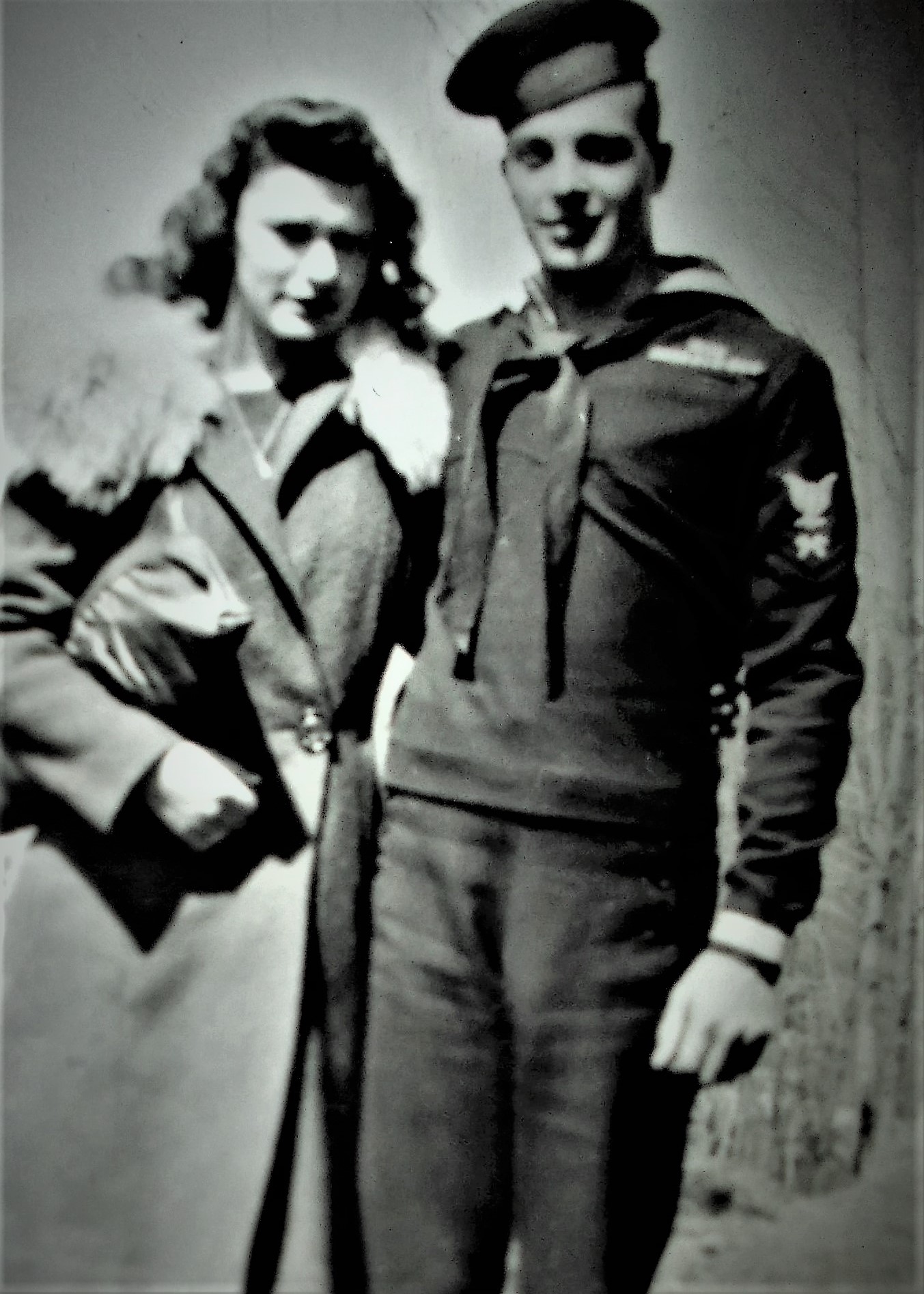
Just two months later, at 17, Paul joined the Navy and was soon deployed to the Solomon Islands aboard the battleship U.S.S. Washington. His world became a whirlwind of waters off Guadalcanal, the Philippine Sea, the Leyte Gulf, then Iwo Jima and Okinawa. Annie’s world became one of loneliness and health problems, worry and wondering. After his ship limped into Puget Sound for repairs in the Spring of 1944, Paul unexpectedly arrived home on leave, surprising and then marrying Annie on April 13th in a hastily-arranged small ceremony at St. Joseph’s Cathedral in Manchester, NH.

Back into warfare in the Pacific just two months later, his world returned to chaos and hers to frailty – the burdens of both worlds acutely heightened and intensified by their new but separated roles of husband and wife. It felt like forever, but it was just eighteen months after their nuptials that Paul was headed home for good, discharge papers in hand. Other than partial hearing loss, he was coming back from  the war unscathed. Physically, at least.

She met his train at South Station in Boston on October 1st, 1945, only a month after the surrender of Japan, marking the abrupt and unofficial end of the war.  Upon seeing him standing there, searching her out in the crowd, she started crying crazy tears. She had imagined on the trip down that she would go flying into his arms, kissing him madly, just like in a scene from one of the movies she had seen back home at The Gardens. Instead, she hesitated, experiencing a brief moment of inexplicable awkwardness, as if the moment may not be real. Then he saw her too. They met halfway, but there was no jumping into outstretched arms. Instead, they locked eyes in silence, hers still glistening from the tears.

He told her he loved her…
she said she loved him back.

Then they embraced, and held on long and tight.

They didn’t let go until Annie’s heart stopped beating on a rainy April night in 1994, just six days short of their 50th wedding anniversary.  The childless couple had made no special plans for their marital milestone. They joked about renting an old black-and-white comedy movie and making home-made sundaes (she would share hers with him, of course), and getting Annie tucked in before her curfew. Some things, however, were just not meant to be, and we don’t have to understand why.

Their love – the one between the cute guy and cuter girl – was genuine and ran deep. Potholes and curves in their long road were not infrequent of course, they never are. Still, they lived their love each day in at least some small way. Sometimes with words, sometimes with actions, but always with purpose and pride.

As Annie’s health declined, they greeted each new sunrise by praying silently together, another subtle concession she gladly made to accommodate his self-consciousness. He had not prayed aloud since he left the Navy, not even at church, which she always attended and he only sometimes did. So praying in silence it was. And it mattered not to her, as long as they were doing it together. Those were precious moments for Annie, who remembered the countless nights she had prayed for Paul’s safe return from the war.

His days since her passing all run together and he seldom leaves the small home where he still feels her presence in every room. He sees her smile in the kitchen , feels her warmth in the bedroom, hears her stories out on the porch.

Paul loved Annie and Annie loved Paul. Neither ever wavered. But then, you somehow already knew that.

Wait. Did I say Paul “loved” Annie?  No, Paul LOVES Annie.

He tells her so, out loud, every morning in his prayers.

And in the stillness of the dawn …
she says she loves him back.
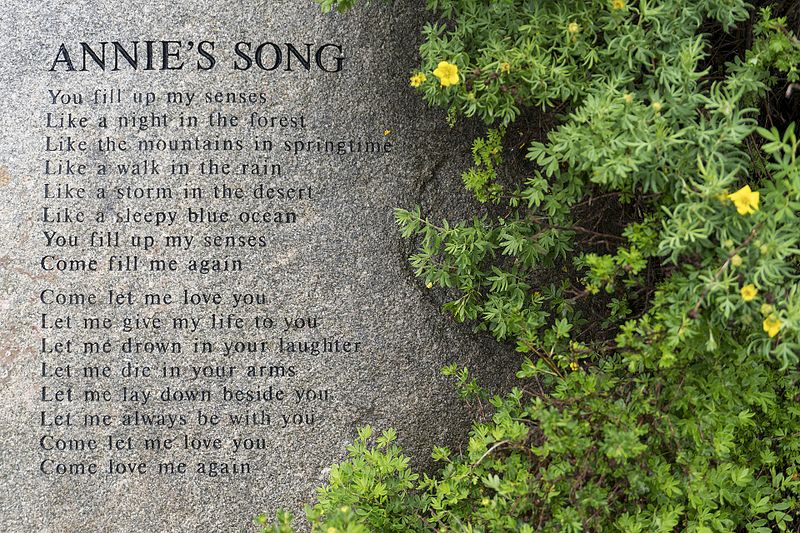
Annie's_Song,_John_Denver_Sanctuary_(27808144296)

Paul & Annie
Thank you both for all you did.  You live forever in my heart. Hope all is well on the other side of the rainbow …

The Fire in Jimmy Louis


Wayne Michael DeHart   (June, 1997)

He endures the emptiness of love lost, of dreams forsaken.
His canvas mourns in brooding browns and ashen grays.
Most say his drive and direction were lost
when she exploded out of his life,
shattering his heart, draining his soul.

The one most likely to succeed, they said.
Ambitious and certain with vision and goals.
But youthful daring and reckless confidence
were too soon manifested in acts of courage in conflict
that brought a hail of hot metal rain to nerve and bone.

Dazed and defeated from the dual punches to his gut,
( the loud rolling thunder of her retreat, and
the lightning-quick loss of his mobility and dignity ),
his memory of her white-hot kisses had faded to black.

But the mortar’s flame and flash and fury had not.

Now, this day, he vows to cast off the shroud that darkens his world,
that shelters his apathy, and shields his despair – and incite the embers
of the flickering,  lonely flame she left embedded deep within.

He will awaken his canvas with glorious greens and glistening golds,
then lay down his brush and wheel himself
into the night
into her sight
into her light
into her life
into her.

Together, they will
find . . .
feel . . .
fuel . . .
the fire in Jimmy Louis.

#

His canvas evolved from this:

background-1134468_960_720

to this.

greenabstractflowersgrayfractalsembrace_www.wallpaperhi.com_93

Footnote: Next of Kin

vsvcr2s
Wayne Michael DeHart  (February, 1997) 

His heart expired at sunset with no one at his side.
The hospital bed was slowly stripped of its linen by
the amiable nurse’s aide ¹ who had blessed him with
winks and nods and smiles, each capturing his gaze.

Nary a flower nor a card had adorned his muted room.
The young girl wondered how this endearing gent
could be forsaken by those whose paths he crossed,
left in silence to struggle alone through his final days.

The doctors had prepared him for the coming of his Night.
The hard news did not surprise him, and he shrugged it off
with a simple nod, amid drifting thoughts about working his
life away, only to to be  prematurely, permanently “retired.”

Days passed. He watched the door through hopeful eyes.
Maybe an old friend, or a neighbor, or someone from work,
would stop by, talk baseball and music, and wish him well,
and remind him that he had been respected and admired.

As time ticked down, no one came to sit down by his bed.
His had been a mostly solitary life of unattended needs;
he filled endless hours of solitude and sadness with idle
speculation and sleepless dreams under unshared covers.

He once loved a Jersey woman who promised him forever.
Then she left quietly in the night of their eighty-third day,
and he soon realized he would never again find such warmth
in the barren eyes and hollow touch of fleeting, casual lovers.

In his fifty-first year, a vicious cancer ravaged his insides.
His restless mind became cluttered in his twilight hours
with the what-ifs and should-haves, the inevitable regrets
of a beaten-down guy who knows he will soon be dead.

He was certain that his passing would hardly be noted.
But while the rest of the staff took the flatline in stride,
the nurse’s aide, a Philly girl, sat down where no one had,
in the never pulled-up chair, right next to the empty bed.

She bid him Good Night and wished him stars in his sky.
Eyes closed, she felt his presence, and paused for a breath,
fondly remembering his face, calmly embracing his grace –
before rising, then looking back, with a last wink and a smile.

¹ She somehow knew that in passing, he found what he had missed.
  Because the girl who touched the spirit of the man
  without a wife was, unknown to both,
  his only child. 

#


Words you can touch – can touch you Back

vsvcr2s
Wayne Michael DeHart

Rescued from the furthest corner of the very top shelf, the nondescript brown book revealed itself to be dusty and dated, seemingly dispensable now after a long-ago demotion from displayed to displaced on the still-sturdy steel shelves of the library’s basement. I sat down in the nearest chair and chose to allow the dust to see another day, gently opening it mid-binding, to a random yellowed page of crowded text and curious font.

I started reading from the top of the left side of page 46, mid-sentence, absentmindedly turning page after page, digesting every word, absorbing each paragraph. Wasn’t sure what I had missed and didn’t care. It was not unlike walking into a roomful of strangers and discreetly deciphering the multi-toned, ongoing chatter flowing from the small groupings surrounding me. The players are out of focus – fleetingly faceless, neighborly but nameless –  enabling me to discreetly follow along, filling in the blanks with my own spontaneous words and thoughts, my own  images and interpretations. 

I began to read at a faster pace, forming opinions of the characters and the events unfolding before me, oblivious to the time ticking by as I made assumptions, while continuing  to fill in the blanks on the fly. I had rolled into the realm of the rabid reading zone, where time stands still and instincts are cast aside like empty Coke cans. 

That is, until a desk phone trumpeted loudly nearby, and my divergence into discovery ended abruptly. My eyes shifted to the bottom of the page – 97 ! Had I really journeyed through 51 pages in a mere few minutes?  A quick glance at the clock on the wall behind me jolted me back in to the reality of a Tuesday morning in November of my junior year of college.  Minutes? Yes, about 75 too many,  and I was due in a classroom across campus at noon.

I gently closed the book, determined to preserve its cloak of noble dust, and stretched to return it to its rightful place on the sleepy top shelf in the musty corner of the basement, there to rest in peace and gather more dust till the next  curious  explorer stumbled along in search of a neglected  literary treasure.

In the years and decades to come, I sought out dusty volumes on the highest  and lowest shelves in libraries and used bookstores from here to there and places in between. The more dust, the more yellow the pages, the greater the anticipation and excitement. And for those volumes, the game plan was always the same – open it up to a random page, start reading, and keep going until a phone rings, my Coke can is empty, or my bladder is full.  And then stop right there, on the proverbial dime.  Put it back in its rightful place, its dust undisturbed, its beginning and its ending left to exploration by another reader, on another day.

All these years later, I can’t tell you the title of that first rescued book. I didn’t forget. I simply never looked. I didn’t want to know because I didn’t want to feel compelled to find a copy of it and just maybe read it from front to back. The experience  was perfect just the way it was – 51 pages of faceless and nameless characters letting me listen in to their story, mid-stream,  thus affording me the gift of completing  the story, fore and aft,  in my words, filling in the blanks from the pages that came before I started reading, and the pages that followed where I left off. In any given instance, I could serve as both author and reader, creator and consumer, maker and user. Always and ever changing. A mystery to be solved.

You know, much like that first old, dust-covered book, waiting patiently to be rescued, its words to touch, and  be touched.

#

#

qqqqr456